Sunday, August 5, 2007

Xie Xie + Zài Jyèn (thank you + goodbye).

A peaceful garden just outside the Forbidden City.

I hope you have enjoyed this look into China, the red star rising. It has certainly been a pleasure to experience and share with you. I would like to say Xie Xie (thank you) to AJ for coming to DC a day early so we could hang out before i left, to Sarah for allowing me to borrow her mandarin books, to Annai for use of his phrasebook (it proved invaluable), to Brad and Sarah for being so good to me in Beijing, to Swan for the translation assistance, to Simone for his insights on China and women, to Mom for never missing a beat, to Sochieta for her inspiration, to Dave for showing me the real BJ nightlife, to Karl and Amy for being so awesome, to Cassie for being such a good commenter, and last but not least.. THANK YOU for reading!

Before i let you go, i'd like to share a few verses with you from my favorite book and regular source of inspiration, the Tao te Ching.

~ verse 6 ~

the Tao is called the Great Mother;
empty yet inexhaustible,
it gives birth to infinite worlds.
.
it is always present within you.
you can use it any way you want.

Offerings to the Gods at the altar of a Taoist temple.

~ verse 33 ~

knowing others is intelligence;
knowing yourself is true wisdom.
mastering others is strength;
mastering yourself is true power.
.
if you realize that you have enough,
you are truly rich.
if you stay in the center
and embrace death with your whole heart,
you will endure forever.

Modernity towers over tradition in the coastal city of Qingdao.

Saturday, August 4, 2007

Expat Life.

My awesome Australian friends and i outside the swanky Q Bar.

ex·pa·tri·ate • \ěk-spā'trē-āt'\ • noun *1. a person living outside his or her own country

Living in Beijing is awesome. I think the one thing that i did not expect was the thriving expat community. There are so many expats from other countries that have come to China to study, work, and live. Considering the rapid pace of activity and blossoming economy, it should not be a surprise that Beijing is such a happening place.

Dancing at my favorite spot - Suzie Wong's.

A Suzie Wong's special.. good times!

I found the expat community in Beijing to be generally very welcoming. I met people living in Beijing who came from all over the world: Australia, Hong Kong, Italy, Russia, Spain, Sweden, the U.K., and even Kansas. It is natural for expats to gravitate towards one another, as we all share something major in common.. we are all foreigners here. We can share our frustrations, with the language, the food, the pollution, the bureaucracy.. but we also can share our successes.

Soccer teammate and Italian friend, Simone.

Playing soccer under the lights.

It didn't take long for me to make friends and fit in to the community. In fact, it is kind of surprising to me how quickly i left my old life behind in the States and began anew. Before leaving Beijing, i had made a number of new friends, joined a soccer team, improved my language skills, knew my way around the city, and even had a few regular hangouts.

Enjoying one of my favorite beers for the first time in years, a Kilkenney.

Dave, Brad, me, Amy, and Karl.

On my last night in Beijing, several friends came out to wish me well. We all agreed that my time in China had gone by way too quickly, and i really felt sad to be leaving this new life behind. But as quickly as it had come, my life in Beijing would be no more. However, the weeks i had there were fantastic and the awesome people i met will remain as friends.

Romaine, Brad, and i ready to rock lady's night at Suzie's.

Several friends helping to celebrate my last night in China.

Dave and i living it up in 'the Jing'.

Wednesday, August 1, 2007

1000 words, or more. (an image collage)

Three men resting inside the Forbidden City.

A picture is worth 1,000 words, right? Well, i took several hundred photos in China and while i won't bore you with them all, i did want to share a few that didn't fit in any of the other posts. Enjoy.

This giant mask is installed outside a gleaming office building. I liked it.

This Taoist monk taking a nap in the courtyard of the White Cloud Temple.

Five newly married couples flock to the beach in Qingdao for photos.

Modern Chinese Art. (watch out for the hand)

More traditional, revolutionary Chinese art.

A street market in Xi'an.

Flowers being planted outside the Temple of Heaven.

One of my favorite buildings. Yes, this is new China.

A street stall selling sweets.. which would you choose?

This guy wanted to take my picture.. so i took his.

And this girl wanted a photo with me.. so i got one too.

Mao's face on just about every yuan bill.
And i thought Washington's face was on a lot of $1 bills!

A rather intimidating sculpture of a very powerful yak.

Monday, July 30, 2007

Terracotta Warriors.

China is a BIG country. Over 1.3 billion people and geographically about the size of the United States. The country is also MUCH older with a very rich history. Somehow i managed to experience the top two most popular attractions in this large country in and around Beijing.. the Forbidden City and the Great Wall. The third most visited site in China is the home of the Terracotta Warriors. No doubt you have seen the photos.

The detail of the soldier's faces and uniforms is incredible.

Now raise your hand if you have heard of Xi'an. This is the average sized Chinese city located in the center west of the country. At over 8 million, this "average" Chinese city would be the second largest in the U.S. (twice the size of LA, just behind NYC). Xi'an is also the gateway to visiting the recently unearthed Terracotta Warriors.

The building that houses the Terracotta Army.

We all have seen the photos, but it was the fascinating details behind their existence that captivated me. Over 8,000 life-size warriors and horses were created from clay, fired in massive kilns, and painted before being buried with the Emperor of Qin 2,200 years ago. Along with the soldiers and horses were over 10,000 weapons. It was believed that the Emperor's clay army would join him in the afterlife to protect and serve him. What is amazing is that this massive underground tomb was not discovered until 1974, when a local farmer was trying to dig a well and struck something unusual.

Over 8,000 soldiers and horses stretch for nearly three football fields.

The site today is covered by a massive building to protect the soldiers while allowing visitors to see the Army for themselves. The soldiers are arranged in a battle formation, with infantry and charioteers led by three rows of elite archers. Each soldier has distinct facial features, and it is believed that the faces were modeled after actual soldiers living at the time. Even the soldier's dress is extremely detailed, down to the rivets holding their armor together. The weapons the soldiers once held were coated with a chrome saline oxide, so that after 2,200 years the weapons are still sharp!

Close-up of soldier and his horses.

The main site has not even been completely excavated. Archaeologists are trying to figure out how to dig out the soldiers without removing their paint, something they have yet to do. Also, since the first soldiers were first discovered, over 180 new sites in the area have been identified as having clay soldiers. The local authorities are trying to decide whether to continue excavating at the main site, or allocate their resources to unearthing the new sites.

Pretty good shape for 2,200 years old.

Being the curious guy that i am, i had several questions. I never hire a guide, preferring to explore a site at my own pace. However, sometimes having a guide is quite valuable for the insight you receive. I pulled aside three Chinese guides leading English groups and asked them all the same question - "The Terracotta Soldiers have facial hair, many have beards in fact, but modern day Chinese don't grow facial hair.. what's up with that?!" The first two guides had no answer, but the third explained that the Warriors were of Mongolian descent. The Mongols do grow facial hair.

Soldiers line up and ready for battle in the afterlife.

It is fascinating to see the Terracotta Warriors. I am quite curious to see if the archaeologists make any new major discoveries, particularly at one of the other 180 new sites. It is entirely possible that an even larger clay army is still out there.. waiting to be discovered.

Saturday, July 28, 2007

Mt. Huashan.

The Soldiers' Trail.

A few days before i left for China a friend told me about his most incredible experience in China. He described climbing Mt. Huashan, one of China's Five Holy Mountains. He said the mountain is extremely beautiful and home to several Taoist temples. Though a challenge to reach, the spectacular views are worth it. Say no more.. there is no way i would miss it.

Everyone takes the cable car up the mountain.. everyone but me.

When the bus group i was traveling with reached the foot of Mt. Huashan, we were presented with two options. Either take the mechanized cable car to the top or hike the punishing "Soldier's Trail" straight up the side of the mountain - guess which i chose? The guide tried to talk me out of it, telling me i would never have enough time to reach the summit before the bus left. I told him i would take my chances.. this is what i came for.

It didn't take long for the views to begin.

Words to live by.

And i was right. The climb up the trail was beautiful. It was also peaceful, as i was the only one out of several thousand who took the trail option that day. On my way up, i encountered a handful of Chinese who had taken the cable car up, but were descending via the trail. They all looked at me as if i was crazy, but all greeted me with smiles and a hearty Ni hao! (hello). I even got a few Lihigh! (you are hardcore/awesome!).

Bridge and waterfall.

This guy lives in a small hut halfway up the mountain.

The trail itself was composed almost entire of stone steps, steps that led up for two miles into the sky. At several points, the steps were no more than carvings into the mountainside. Luckily, whomever built this trail (i am assuming it was soldiers, hence the name) thought to include heavy chains bolted into the rock. As you might imagine, this made climbing the carved steps possible.

This is exactly what i came for.. oh yea!

A view from halfway up the mountain.

After several grueling, sweaty hours, but less than half the time that the guide suggested, i reached the summit. As i paused to catch my breath and cool off, many of the cable car riders stared at me as if i was an alien. They were probably thinking “Who the hell in their right mind would want to CLIMB up here?” The answer: this guy.

I wish more mountains were made this way - climbing is fun!

The top of the mountain is home to several Taoist temples. It also hosts several shops and food stalls. I was completely dismayed to discover not hundreds, but thousands of Chinese tourists pouring out of the cable car and flooding the mountaintop. The crowds were so thick, it literally had the feel of being at Disneyland.

Temples and crowds.

A Taoist temple with incense sticks burning.

I didn't stay on the mountaintop long. After battling the mountain in relative peace during the climb up, i didn't feel like battling the crowds on top. After checking out a temple or two, and with time running downfor me to meet the bus back to Xi'an, i climbed into the cable car with five strangers and floated back down the mountain.

The Disneyland crowds line up for the cable car ride down the mountain.

Thursday, July 26, 2007

Beijing Olympics 2008.

The official 2008 logo.

I have a confession to make. When Beijing was announced as the host for the 2008 summer Olympics back in 2001, i was disappointed. I had been pulling for Paris, simply because it is one of my favorite cities in the world. Also, many felt that awarding Beijing the Olympics would be seen as condoning China’s human rights violations and its occupation of Tibet. Still others felt that hosting the Olympics would put pressure on China to reform and modernize. In short, both are coming true.
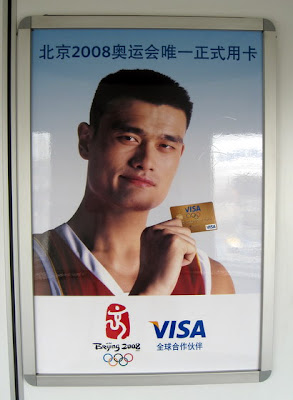
China's prodigal son, Yao Ming is a force on the court and in advertisements.


Hosting the Olympics is a huge opportunity for the host country. Billions of dollars in tourist revenue and corporate sponsorships flood into the country. The host city benefits from the construction of new roads, subway systems, and state of the art sports facilities. But possibly the most important aspect of hosting the Olympics is the global exposure a city and country receive. If the games are seen as successful, tourism and general worldwide interest will continue for years.

Think Beijing is excited? The countdown is on.

In 2004, Greece was running far behind in its preparations as Olympic hosts. Several facilities hadn’t even begun construction just months before the games were to begin. There was even word of a backup plan that would send the Olympics back to Sydney in the event that Athens failed to be ready. In China, the story is completely different. Beijing just may be the most prepared city in the history of the Olympics.

China's Olympic slogan - One World, One Dream.

It is still over a year before the games will take place, but Beijing is far ahead of schedule in its preparations. In the next few weeks, the city will stage a “dry run” of the Olympics - a full year before the real games. Over a million cars will be taken off the streets and mock events will be held to test crowd control and transportation facilities. It also gives the city a chance to show off its new facilities to the public.

The Olympic mascots all wrapped up and ready to go.


Construction is taking place all over the city and the completion date for everything being built is the same – before the Olympics begin. Over two million Chinese migrant workers have come to Beijing from other parts of the country for the current construction boom. A few months before the games, they all will be kicked out. I spoke with a reporter for a state-owned Chinese newspaper and when i asked him about this, he put it differently: “These workers aren’t actually from here, so they’re not being kicked out. They will be encouraged to return to their home provinces.” In China, encouraged means mandatory.
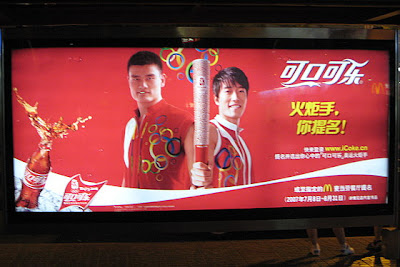
Corporate sponsorships are already in full swing.

After seeing firsthand such dramatic improvements, i am now very glad that Beijing has the opportunity to host the 2008 games. Paris is already a great city and has less room to improve. The Chinese people are so proud to be hosts and are eager to show their country off to the world. Still, i worry that China’s growing economic muscle and international profile is enough for the global community to turn a blind eye to many of the unseemly activities that still occur behind closed doors. I also worry about the future of Tibet, with sovereignty becoming less and less likely, China is working hard to see that the culture is quietly being extinguished. In the end, there is little doubt that the Olympics will be a smashing success - the Chinese wouldn't have it any other way.

Advertisements every 20 feet in the Xi'an airport.

Tuesday, July 24, 2007

Grocery Shopping!

Ni hao! Look familiar?

When i found out there was a Wal-Mart less than a mile from my apartment, i just HAD to check it out. I'm glad that i did. Not only was it a fascinating experience, but an MBA group from Notre Dame that was in town went there for a "field trip".. so i didn't feel so silly. The inside looks pretty much like Wal-Mart stores do back in the States, but everything for sale is different.

Wal-Mart's aquarium aisle, and no, these fish aren't meant as pets.

The fresh fish section is huge, and when i mean fresh, i mean ALIVE. The woman in the picture was checking out her potential dinner when a bagged fish started flopping around on the counter. She shrieked, while i tried to not let her see me laughing. A friend explained to me that the Chinese like to see their food as fresh as possible. Often times this means that the food on your plate looks like it was alive 20 minutes ago, and that just may be the case.

You won't see this for sale at Wal-Mart in Arkansas.

In case you can't get enough fresh seafood, there is plenty to
be discovered in the DRIED seafood section. I hear it lasts longer.


Apparently, Wal-Mart isn't doing so well in China. Their business model in the States relies on low cost products.. from China. So when you start selling in China, where do you get products that are lower cost than everyone else's? Also, it is expensive and difficult to maintain distribution of the fresh (or alive) food products that the Chinese crave. Still, with nearly 80 stores in the country, they are pressing forward as they work out the kinks.

There is all this China food safety talk in the news right now..

but these wrapped up vegetables look like the safest i've ever seen!

Breakfast cereal and coke. Can someone explain this to me?

Monday, July 23, 2007

Lost in Translation

I have traveled to a country or two and have always prided myself on learning the basics of the local language. I have found that people really appreciate it when you attempt to communicate with them in their own language. Prior to coming to China, i checked out the Pimsleur language CDs for Mandarin and began practicing. I also borrowed language books from two different friends and began learning the basics.

An average storefront.

By the time i reached China and began practicing my new language skills, it all fell apart. You see, unlike any other language i have encountered before, there are four tones in the Chinese language. This means that one word, for example “ma”, can be pronounced with a flat (ā), rising (á), falling (à), or rise then falling (ă) sound. The result is four completely different words. Now imagine a single word with multiple tones, such as “néehăo,” which means hello. Try and string several words together with multiple tones and it gets real tricky real fast.

A man write Chinese characters at night with a sponge brush and water.

Often when i think i am saying the correct word, the pronunciation is so difficult i am rarely understood. To complicate matters even more, you will often see Latin letters beneath Chinese characters to “aid” non-native speakers. This is called pinyin. However, the Latin pinyin spelling is rarely phonetic and only leads to more confusion.. and we haven’t even gotten to the Chinese characters yet!

A few things are easier to translate than others.

So i have been reduced to pointing at Chinese characters in my mandarin dictionary, jabbing at maps, or using the few words i can say that are understood to get around. For example, the word “jiga” means “this”, so by pointing in a direction and saying “jiga jiga” i can get a cab driver to go in the direction i think is correct.

A restaurant, barber shop, or laundromat? Your guess is as good as mine.

In the English language, we have 26 letters in the alphabet. Meanwhile, some Chinese dictionaries have over 100,000 characters! However, the average educated Chinese person knows only around 600-800 characters. Each character corresponds not only to a sound, but also has meanings attached to the character. It is common in China to have business cards in English on one side and in Mandarin on the other. I asked my colleagues at work to help me come up with my Chinese name. They chattered excitedly in Mandarin, debating the most appropriate fit for both my current name and my personal attributes. After a fair bit of debate, i was presented with my Chinese name.

My Chinese name is spelled “Hè Wén Qíang,” pronounced “Huh when chee-ong,” and has several meanings. In Mandarin, the last name comes first. I share my family name, hua, with a great modern general in the Chinese military. I am lucky to have such a prestigious name. I have an Australian friend here who was given a name that loosely translates to “horse sex.” Needless to say, the Chinese have a good laugh every time he presents his business card.. poor guy!

Saturday, July 21, 2007

Chinese Food, in China.

It's family style here in China - dig in!

One of the great things about traveling is trying the local food. But we all have had Chinese food, right? What you may not realize is that you probably have only eaten American Chinese food. I don’t think i have had a single Chinese dish here that looks anything like the Chinese food found in Western countries. In China, there is no such thing as “Chinese food.” Instead, you can choose from cuisines derived from various regions of the country. A few examples include Guangdong, Guangxi, Hakka, Hunan, Imperial, Jiang-Zhe, Shaanxi, and last but not least, the often mouth numbing Sichuan.


A sampling of hot and spicy Sichuan dishes.

A highly stylized dessert.

Sharing a meal in China is a bonding experience. Nearly every business meeting i’ve attended finished in us sharing a meal together. This is not a bad thing at all. One thing that surprised me is that a giant lazy susan is usually found at the center of every table, while each dish is served in succession family style. It’s fun catching your food as it slowly spins by.

Some friends and i share an awesome meal.

A typical street food stall.

Street food is also quite popular in China. You can find everything from dog to scorpion grilled up and served on a stick. I prefer to stick to the more conventional lamb and chicken. After a night out drinking with some friends, i asked where we could get something in eat. In Arizona and California the late night food is Mexican, in DC it’s jumbo slice pizza or empanadas, and in Beijing its grilled kebabs of meat. The kebabs are grilled over an open flame and served up piping hot. They also are super cheap.. about 13 cents for each one. So we ordered up twenty!

Grilling up our order of kebabs.

Preparing to dominate a lamb kebab fresh off the grill.

Monday, July 16, 2007

Work Life.

Our office in Beijing is my organization's single largest office in the world. Kind of gives you the impression that the U.S. perceives China as important, doesn’t it? In Beijing alone we have a staff of over 70, while our numbers total 140 throughout China. Many of these employees are Chinese who are bilingual and assist us in making connections with the local business community.

That's my office on the top floor.

I am currently working on the 31st floor of a high rise building in downtown Beijing. The U.S. Embassy building is just a few blocks away, but space there is limited. A brand new Embassy building is currently being constructed, and when it is completed in 2008, all U.S. personnel will be consolidated under one roof. With the Olympics around the corner, it seems as if everything currently under construction is set to be completed before the games begin.

The view from my office, showing off the best air quality since i arrived.

Foreign service officers rotate to their new posts during the summer months and gaps between officers are a regular occurrence. I am currently filling in the gap for an officer who recently left for Australia, while the next officer prepares to arrive from DC in August. It is a fascinating life, and the officers i am working with are all very dynamic.

The view on an "average" day; on a "poor" day, i can't see ANYTHING!

In addition to the Foreign Service officers, we work with quite a few Chinese. My Chinese colleagues are quite savvy and their dedication is inspiring. They also have made every effort to make me feel welcome. My first week, several of my new colleagues offered to take me out for lunch to a famous local restaurant. The food was fantastic!

Our male colleague who was invited couldn't make it.. seriously!

Beijing Hikers.

Beijing Hikers exploring natural China.

Shortly after arriving in China I picked up several local English papers to see what is happening in Beijing. I am still blown away by the sheer number of options you have as a Beijing resident. Regardless of your interests you are sure to find something interesting. The city offers everything from tango classes, calligraphy lessons, art exhibitions, Chinese opera, live jazz, organized mountain bike trips, and even pickup games of cricket. In terms of culture and activities, I feel Beijing is right up there with DC.

My first weekend I linked up with Beijing Hikers, a local group that heads outside the city every weekend to get some fresh air and explore the natural environment. As you all must know by now, this is right up my alley. I was excited to get my first glimpse of China outside the capitol.

Our group of 14 met up at a Starbucks just before 7am and we all piled into the minibus waiting nearby. An hour later, we were outside the city and winding up the side of a steep green mountain. Despite being so close to the city, the area in which we were hiking is very rural and a number of farmers could be seen working their small fields.

Not what you'd expect to see in China, is it?

We began the hike in a small village and were soon pressing through lush vegetation at the bottom of a canyon. In some ways, the area reminded me of Shenandoah in Virginia. After a few hours, the canyon opened up in spectacular fashion. The group scrambled over rocks and helped each other along as we continued on our way.


I met an awesome Australian couple named Karl and Amy during the hike. They are originally from Melbourne, so we had plenty to talk about. Karl works as an editor and amateur photographer for a major newswire service while Amy works for IBM. After several years in Hong Kong and Singapore, they moved here. They were pretty impressed with my knowledge of Australia, especially the fact that I still follow the footy (Aussie rules football). In case you are wondering who i barrack (root) for, the Hawthorn Hawks are my side. They are currently in 2nd place out of 16 teams and are having their best season in years!


My first encounter with the Great Wall.

I knew that we would get to see a remote section of the Great Wall on the hike. What i did not realize is that i would get to see the 'Wild Wall.' The sections of the wall most visited have been rebuilt in order for tourists to see how the wall once appeared. The section we visited is how most of the wall (or what is left) appears today.


Truly.. the nickname Wild Wall is well deserved.

Remnants of the guard tower.

Personally i prefer Wild Walls over tame walls.

Thursday, July 12, 2007

Tai Chi + Chinese Fitness.

Welcome to Ritan Park.

If you really want to get a feel for Chinese culture, a visit a city park in the morning is an absolute must. The local park is a place that is buzzing with activity, with groups of people practicing tai chi to couples practicing dance steps, friends playing ping-pong or people working out on the parks many “exercise machines.” In some place, calligraphers write Chinese characters on the sidewalk with sponge brushes and water, the ultimate exercise in impermanence. Elderly men bring their birds in cages, and while the men sit and catch up with one another, it is said that the birds get their workout by clinging to their perches.

Large groups practice taijiquan.

Women practice their dance steps.

On Saturday I got up at 6am to meet my taijiquan (tai chi) instructor at the large park near my apartment called Ritan Park. My colleague at the Embassy put me in touch with her son’s martial arts instructor, Dong Li Jian. Full of energy and extremely strong, Dong agreed to meet me for an introductory lesson to tai chi. Although he doesn’t speak English, and my mandarin is basic at best, we were able to communicate with hand signals and pantomime. After all, much of tai chi is based on imitating the motions of those around you.

Ping pong is extremely popular in China.

Advanced practitioners perform tai chi exercises with swords

Parallel bars, anyone?

Tai chi is widely practiced in China, and it is not uncommon to see folks well into their 60s and 70s moving fluidly with the motions of the group. I was attracted to tai chi for its meditative element. However, tai chi is still a martial art, and significant attention is given to posture and correct form. It is similar to yoga in that your entire concentration is focused on the motions of your body and your breathing, while the tensions of everyday life are simply pressed from your mind.

Practicing taijiquan with my instructor.

Dong Li Jian and I.

After my lesson with Dong, I strolled through the park and was both amazed and amused by what I encountered. More than anything, I couldn’t believe the level of physical activity by people of all ages. I have never seen this is any other country, and cannot even imagine Americans exercising together en masse on a Saturday morning. The trail near my house sees people jogging or biking on the weekends, but here many of the activities are done in groups. Collectivists vs. Individualists.. perhaps?

See below for some additional photos and several videos!

Exercise machines in full effect.

Gearing up for the Olympics!

Some folks playing cards.

VIDEOS!

Man practicing his ribbon flow.


Exercise machines in action!


I love this one.


I call this one the "butt machine."


And you thought Jazzercise was exciting.


The Chinese version of hackey sack.

Sunday, July 8, 2007

the Forbidden City.

Entering the Forbidden City.

The Forbidden City lies just beyond the Gate of Heavenly Peace and was originally constructed between 1406 and 1420 by over a million laborers to showcase the Emperor's power and wealth. Over the next 500 years, the complex was added to many times over by successive emperors and today is comprised of over 800 buildings. The 14 Ming and 10 Qing Emperors who resided here lived a life of absolute luxury, sealed off from their kingdom on the outside.

The Forbidden City truly is a city unto itself.

It wasn't until 1949 during the People's Revolution that the City was first opened to everyone. Today, the city is remarkably well preserved and acts as a window into the rich dynasties that rules for centuries. It is not just foreign tourists who flock here. Many Chinese come to see the splendor that was kept hidden from them for so long.

All of the renovation takes place by hand. It can take ten years to complete one section.

But the payoff is well worth it.

The detail is extremely impressive, not to mention beautiful.

I particularly love the names of the various halls and palaces found in the Forbidden City. A sampling includes the Hall of Supreme Harmony, the Palace of Heavenly Purity, the Palace of Earthly Tranquility, and the Thousand Autumns Pavilion. Each hall was built at a different time under a different Emperor and stands as a testament to that Emperor's reign.

Inside the Hall of Preserving Harmony

The physiology may be off, but skill of the craftsman certainly isn't.

It surely was a sight when these hand carved fountains sprung alive.

This zoomed in shot shows just one corner of a rooftop, the details are incredible!

My Beijing pad.

My apartment building in Chaoyang

I am living in an awesome part of the city called the Chaoyang district. This area is close to several embassies and is known for its large expat population. As the crow flies, i am situated just about a mile and a half due east of Tienanmen Square. I love it because it is just a two block stroll to work in the morning (best commute ever!) and the subway station Guomao is literally steps away. I have no trouble getting around the city using the subway or taking taxis. The apartment building is a bit of a landmark, and though my Mandarin is limited, cabdrivers seem to know the location well.

China World Apartments.

The driveway entrance to my building.

My work has put me up in a posh apartment in the China World complex, which includes restaurants, a supermarket, countless stores, and even an ice rink! Several of my colleagues live in this building as well, so it makes meeting up to go out a snap. The apartment has its own full kitchen and washer and dryer, which is super convenient. And last but not least, my room is serviced each day, so i don't even have to make my bed!

My bed. Pillows anyone??

The bedroom.

Bathroom.

Living room.

Kitchen.

Thursday, July 5, 2007

Beijing: First Impressions.

After a 13 1/2 hour direct flight i was eager to stretch my legs and explore the city. Despite all of the dire descriptions i'd heard about Beijing's terrible pollution, i was pleasantly surprised to arrive on a very lovely sunny day. Only later did i find out that major rain the day before had cleared the skies resulting in the most beautiful day anyone could recall in months.

A favorite of mine, this series depicts the four seasons.

I checked into my plush apartment and hit the streets. Just seconds after leaving my building, two friendly college students approached me and began chatting me up. A few minutes later, they invited me to check out their school art exhibition. Being the art lover that i am.. i quickly accepted the invitation. The art was being displayed in a small gallery and they eagerly showed me around, pointing out the symbolism in the pieces and shyly displaying their own pieces.

This friendly art student displays her art.

Though several of the pieces were quite good, after i had seen it all came the pitch.. "We are college students and really need to sell something. Today is the last day of the exhibition and your only chance to buy our work." I took down their mobile numbers but told them i wasn't in the market for any art that day. In the next hour, i met half a dozen art students who all happened to be having exhibitions that day.

Beijing's modernity is evident everywhere.

As i took in the city on my way towards Tienanmen Square, i marveled at the modern buildings and well manicured boulevards. When i finally arrived at the Gate of Heavenly Peace i was awestruck. Though i had seen the photos, there is something incredibly dramatic about the sudden openness of Tienanmen Square and austerity of the Gate featuring Mao presiding over the China he forged. You cannot help but feel that this place is the heart of Communist China.

The Gate of Heavenly Peace

People mill about everywhere, mostly Chinese tourists who have made a pilgrimage to see their capital. Republic guards stand watch to ensure that no one gets out of line. This is the place that Mao declared the founding of the People's Republic of China in 1949. When he died in 1976, millions from all over the country came here to pay their respects. And in 1989, this is where students supporting democracy were slaughtered in the thousands.


As i snap picture after picture of the Square and Gate of Heavenly Peace, two Chinese girls named Vicky and Nina (it is not uncommon for Chinese to select English names in addition to their regular names) strike up a conversation. They ask if we can practice speaking English together. Both girls are currently studying English and Chinese history in hopes of finding jobs as tourist ambassadors during the Olympics next summer. Although i am always on the lookout for scams, their friendly and earnest demeanor put me at ease. They suggest showing me a nearby hutong, or historical neighborhood. After a few hours walking in the thick warm air, the girls assure me that a cold beer can be found there and we set off together.

It looks like somebody always wanted to be a soldier - check out the guy in the back!

Just outside the walls of the Forbidden City, we made our way down a leaf shaded side street through the hutong to a small tea house. We are ushered into a small elaborately decorated room. A cold Tsingtao beer appears before me within moments. The girls ordered tea and said a "traditional tea ceremony" would be performed.. awesome. Fresh watermelon and small cookies were served automatically. The tea hostess performed an elaborate mixing and straining of the various teas before serving them in tiny cups. Though i had only ordered the beer, the hostess invited me to sample the teas as well. The teas themselves were very strong in both aroma and flavor.. quite delicious as well.

The tea hostess whips up a batch of tea.

While we sipped the tea, we chatted about Chinese history and the tea we were sampling. The tea hostess didn't speak English, so Vicky and Nina translated the various tea descriptions. Nina asked for my help with a written English lesson, and i obliged. The tea hostess offered some loose leaf tea for us to take home, but i passed. A few minutes later she returned with the bill, and that is when the trouble started.

Vicky offers a toast.

Enjoying some tea, in happier times.

The bill was presented to me and i was astonished to see a total of 1,500RMB. Though i had just arrived in the country a few hours earlier, it didn't take me long to calculate that the tea hostess was asking $200 for the beer and tea! The beer i ordered cost just $3, but each mini cup of tea was listed as $7 per person in addition to a "room rental fee." I knew something was amiss when Vicky and Nina tried to convince me to just cough up the cash for all of us or else "we won't be able to leave." I protested, telling them the only thing i actually ordered was the $3 beer. This went on for several minutes before i realized i needed to get out of there.. and fast. I put down $10 for my beer plus a tip and got up to leave. Once outside, my two new "friends" suddenly were not so friendly and said they had to be somewhere all of the sudden.

All lit up, the mood is almost festive.

Standing guard: the Gate is now closed.

It was dark now, and feeling a bit disappointed in the traditional tea ceremony i made my way back to the Gate of Heavenly Peace. A friend told me not to miss the Gate and Square at night, and he was right. Lights came on to give the place an almost festive feel. I grabbed a seat on the curb and just watched the life around me for several minutes. Young couples strolled along the boardwalk while laughing children chased each other and entire families posed for pictures with Mao. A soft pleasant breeze helped to remind me that while i was a long way from home, some things are always the same. Thankful to be alive, and feeling incredibly lucky to have this experience, i set off into the night.

"Wherever you go, there you are"

Tuesday, July 3, 2007

Chinese Etiquette


As you might imagine, Chinese culture is much different from Western cultures. Before taking off on the 13.5 hour direct flight, i printed out several pages with "helpful hints" and reminders about how to behave in China. Below are several of my favorites:
  • Behavior: Do not try to become too friendly too soon.
  • Behavior: It is considered improper to put your hand in your mouth.
  • Behavior: Do not eat all of your meal. If you eat all of your meal, it will be assumed that you did not receive enough food and are still hungry.
  • Behavior: The Chinese are not as understanding of drunk guests as the Japanese. If you feel you've had enough to drink, smile and politely indicate this to your host.
  • Communications: Avoid telling American style jokes. Sometimes these jokes do not translate and can cause confusion or hurt feelings.
  • Communications: Many Chinese will want to consult with the stars or wait for a lucky day before they make a decision.
  • Communications: Do not use the word "comrade" to address others.
  • Taboo: Under no circumstances should chopsticks be placed in rice standing up. This symbolizes death.
  • Taboo: Never write anything in red ink
The Chinese character for "prosperity" composed of butterflies.

Gift giving is an important part of building guanxi, or the relationship bond between people. I particularly appreciate this attitude towards gifts:

Do not expect your gift to be opened in your presence.
This indicates that it is the thought that counts more than the material value.


Detail of "Prosperity" butterflies

China: An Introduction

China is home to over 1.3 billion people. Slightly smaller than the United States in size, the People’s Republic of China (or PRC) is the single most populated country in the world (the U.S. population is about 300 million). Since instituting market reforms a number of years ago, the Chinese economy has exploded like a rocket headed for outer space. Such dramatic growth generates unprecedented development and prosperity. It also brings pollution and greater scrutiny of labor practices. And in case you forgot, the country remains very much a Communist nation.

Men crowd around to watch a chess-like match

Just a few weeks ago i found out that i would have the opportunity to live and work in Beijing for a month. It couldn’t be a better time to be in China. All eyes will be on the country next summer when Beijing hosts the 2008 summer Olympics. Meanwhile, business activity is at a fever pitch. Investors and businesspeople from around the world are eagerly pursuing opportunities in China hoping to grab a slice of the proverbial pie.

Construction cranes remake the city skyline

In order to prepare for this experience, i began studying Mandarin and tai chi in the weeks leading up to my departure. I also picked up several books, including Paul Theroux’s Riding the Iron Rooster, which details the surly but perceptive travel writer’s travels through China by train. Another book i am reading is titled, get this – Foreign Babes in Beijing. This is the true story of an American woman who moved to Beijing right out of college and stumbled into a starring role in a hit Chinese television series of the same name. Her writing is fresh and provides a very insightful account of what it is like to experience Chinese culture as an outsider.

Gleaming skyscrapers show off the new Beijing

I am extremely excited to see firsthand what all the buzz is about. I hope you follow along and enjoy some of the experiences i have to share. As always, your comments are welcome!